For the best experience, please rotate your phone or switch to a larger screen.

Horizontal viewing is recommended for full access to this section.

Ariana Leon
Interview
< Back
Bio   +
Contact   +
01 Was there a defining moment or specific event that made you seriously think about the meaning of making art?
03When you encounter material limitations or technical challenges, how do you usually respond or adapt?
05For those who have never experienced your work before, what do you most hope they see or feel? and why?
07If you had unlimited time and resources, what project would you most want to realize?What would it mean to you?
09In some of your installations, the work seems to create passages, links, or channels between different surfaces in the space, such as the floor, wall, ceiling, and architectural edges. These sculptural gestures give the work a strong visual volume, almost as if the space itself is leaking, breathing, or under pressure.

How do you think about the relationship between sculpture and architecture in your work? Is this spatial expansion a form of release, exposure, or bodily pressure?
02 How do you balance rational thinking and intuitive expression in your creative process?
04Do you mind if viewers interpret your work differently from your original intention? In your opinion, does the artwork belong to the audience once it is completed?
06 Have your personal life experiences, such as geography, culture, family, or education, influenced your practice? Could you share an example?
08Many of your works seem to borrow from the visual language of parties, consumer objects, and Pop-like sculpture, but they do not remain celebratory or decorative. The objects become enlarged, isolated, and strangely bodily.

How do you think about this tension between seductive commercial surfaces and the more vulnerable or traumatic histories that your sculptures carry? 
10Some of your smaller-scale works and sculptural gestures seem to function differently from your larger installations, operating more intimately or fragmentarily.

How do these quieter works relate to your broader sculptural language?
< Back
01
It's coming, like too much
2024
Wood, metal, foam, plaster, paint
Dimensions variable
Do you mind if viewers interpret your work differently from your original intention? In your opinion, does the artwork belong to the audience once it is completed?
I didn’t plan on becoming an artist, but somewhere along the line of my experiences, I found myself sitting at a desk realising I could no longer find value in my aspirations - or understand their purpose within the greater world. What felt meaningful to me was art. I had things I needed to share, words I could never speak aloud, and it felt as though visual imagery or fragments of language were the only ways I could communicate them.

I began studying photography and video, but quickly became frustrated by the limitations of representational imagery. There was only so much that could happen, only so much I could control, and when I came close to the output I wanted, it felt too literal. I moved toward sculpture, where I discovered my love for conceptual art: for the way bodies instinctively respond to objects, and for a medium in which at least one side is always hidden from the viewer.

It was there that I realised how deeply art could connect someone to their own body and to themselves. I began to understand art as a way of approaching difficult subjects without exploiting the body directly, without triggering survivors through literal imagery, and without needing to define violence explicitly.
< Back
02
Happy Birthday, Sweetie
2023
Mylar, cardboard, wood
78" x 78" x 48''
How do you balance rational thinking and intuitive expression in your creative process?
I think anything can be rationalised when it is placed within the right context or world. So rather than trying to separate intuition from logic, I build systems where intuition becomes its own kind of rational structure. The emotional response, the bodily instinct, the material attraction - those are not interruptions to thinking for me, they are the thinking.

Usually the work begins with an image, sensation, or physical impulse that I cannot fully explain at first. I become fixated on a shape, a texture, a behavioural relationship, or a spatial tension, and then the conceptual framework emerges through making. I don’t begin with a fully articulated thesis and then illustrate it. Instead, I follow an instinctive attraction toward something and slowly uncover why it carries weight for me.

At the same time, the process itself is highly considered. I think very carefully about scale, bodily movement, spatial relationships, material tension, and how a viewer might physically encounter the work. There’s a kind of choreography involved. I want the work to guide the body before the mind fully catches up.

I also think intuition is deeply informed by lived experience, memory, and conditioning. Even when something feels irrational or visceral, it is still shaped by everything we have absorbed psychologically and physically. So for me, intuition is never separate from intellect - it is simply a form of knowledge that exists prior to language.
< Back
03
I beg you, coat my tongue
2024
Rubber, wood, paint, metal
44" x 4" x 44"
When you encounter material limitations or technical challenges, how do you usually respond or adapt?
I approach art quite systematically. Once fabrication begins, the conceptual core of the work is usually already fixed, so the process becomes about problem-solving: what material can be manipulated to produce the sensation, tension, or bodily response I am trying to create? What structural logic needs to exist for the image in my mind to become physically possible?

Because of that, I’m not especially loyal to specific materials. I’m more committed to the psychological or bodily effect of the work than to the medium itself. If something fails technically, I don’t see that as a collapse of the work - I simply begin searching for another material language capable of carrying the same emotional or spatial weight.

A lot of my process involves testing how far materials can be pushed before they begin to feel unstable, vulnerable, swollen, or excessive. I’m often interested in moments where materials appear as though they are under pressure or behaving beyond their intended function. Technical limitations can actually become useful in that sense, because failure, strain, collapse, or awkwardness often carry the same emotional qualities I’m trying to speak through.

I also think material adaptation mirrors the conceptual concerns of my work. Bodies adapt constantly. Trauma adapts. Architecture adapts. Systems continue functioning while under enormous pressure. So the process of reworking structures, finding substitutions, or forcing materials into unfamiliar behaviours becomes conceptually tied to the work itself.

Sometimes the most important part of fabrication is allowing the material to resist me slightly. That resistance creates negotiation, and often the final work becomes more complex because of it.
< Back
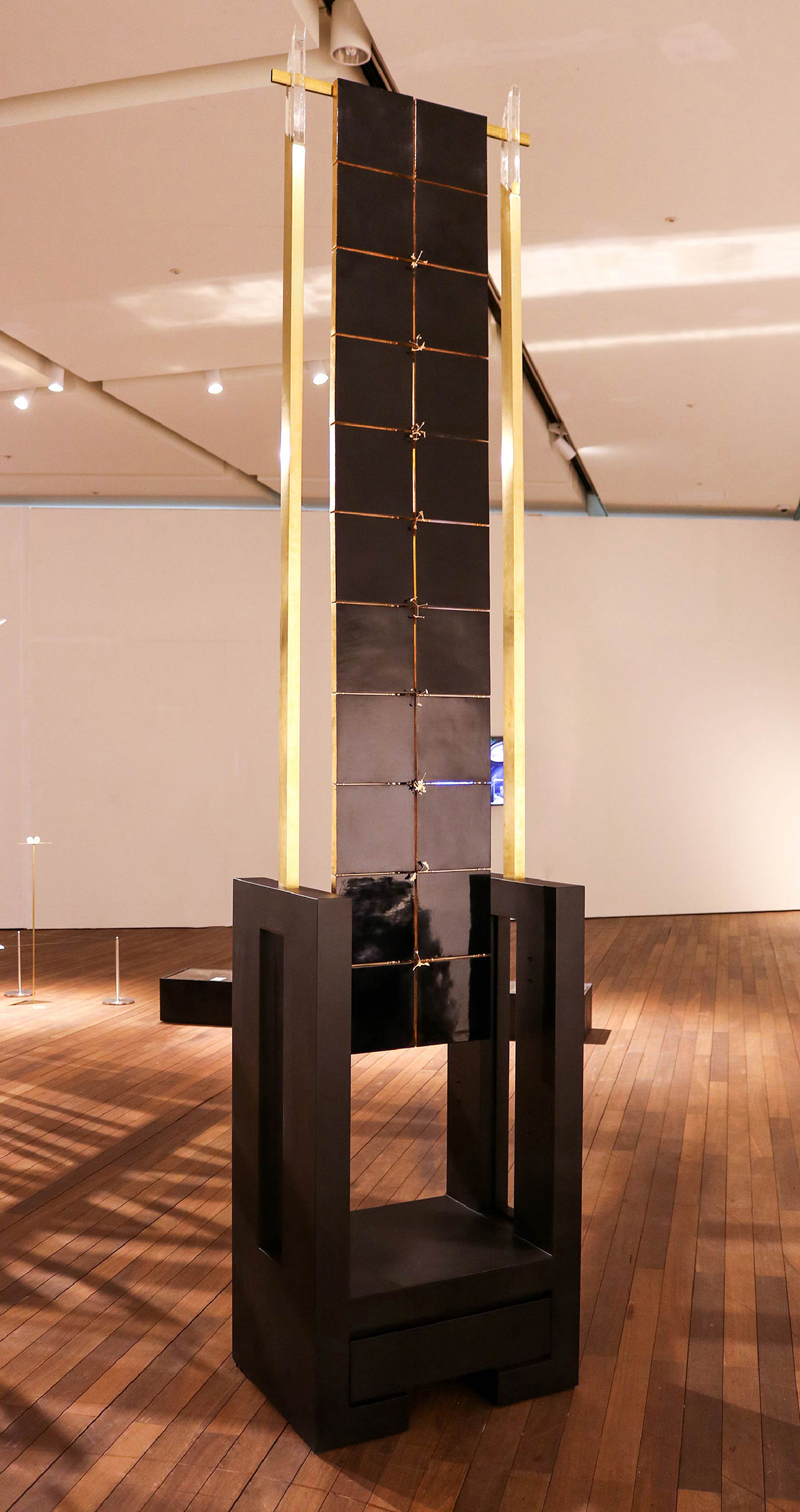
04
T-axis: the entrance/clock of the ghost’s room
Sap of the lacquer tree, fake glit, brass, MDF, OHP film, spray paint, clock movements, resin and mixed media
114.2 x 35.4 x 23.6 inches, 290 x 90 x 60 cm
2022
Do you mind if viewers interpret your work differently from your original intention? In your opinion, does the artwork belong to the audience once it is completed?
My work is an epistemological exploration that often engages with myth, ritual, and systems of belief—so I consider different interpretations not only inevitable, but essential. Observing how viewers respond, especially when their reactions diverge based on personal backgrounds such as religious belief or cultural experience, allows me to understand how visual language resonates across boundaries. For instance, when a work draws from sacred spatial structures, those with religious affiliations often respond very differently from those without. I find these moments of contrast generative—they often inform the conceptual direction of future works.

Once the work is completed and presented in an exhibition, I see it as a shared encounter. The audience brings their own world to the work, just as I brought mine. Rather than believing that the artwork belongs solely to the artist or to the viewer, I see it as a site of exchange—where worlds overlap, interpretations multiply, and new meanings emerge through engagement.
< Back
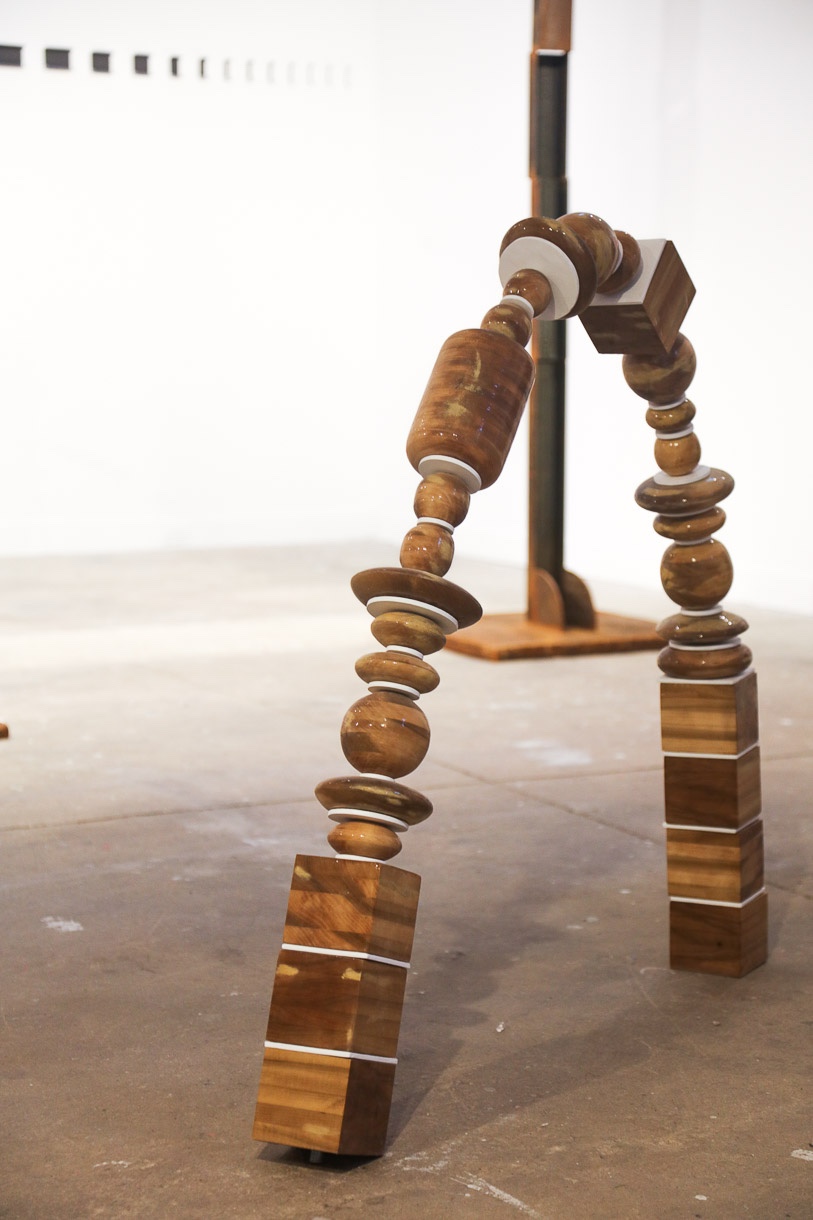
04
When two become one (and it feels so good)
2024
Rubber, wood, enamel
Dimensions variable
Do you mind if viewers interpret your work differently from your original intention? In your opinion, does the artwork belong to the audience once it is completed?
I absolutely believe I cannot control the interpretation of my work, and I’m very comfortable with that. Different viewers will bring different histories, associations, and emotions to the work, and that openness is important to me.

At the same time, I do think it is my responsibility as an artist to guide someone toward the emotional or conceptual space the work is operating within. If a viewer cannot approach that space at all, then I need to reconsider the visual cues I’m providing, the experience I’m constructing, or the language the work is using. In that sense, the work becomes a kind of negotiation between my intentions and the audience’s encounter with it.
< Back
05
Oh! Baby!
2023
Mylar, breath, vinyl, ribbon
40" x 40" x 168"
For those who have never experienced your work before, what do you most hope they see or feel? and why?
More than anything, I hope they become aware of their own body. I hope they notice how they move through the space, the distance they keep from the work, the instinctive reactions they have before they intellectually understand why.

I also hope they notice the thoughts that surface while they’re experiencing the work - thoughts they may initially assume are unrelated. I believe they are related.

My work often uses imagery that is not immediately recognisable as being connected to the body or to trauma, but those connections are there. I think viewers can only arrive at them if they are allowed to approach the work freely, without being told exactly what to feel or how to interpret it.
< Back
06
See how it likes to open
2025
Foam, resin, paint, plaster, wood
Dimensions variable
Have your personal life experiences, such as geography, culture, family, or education, influenced your practice? Could you share an example?
I’m deeply influenced by my personal experiences. Everything that has happened to me has shaped the ideas I return to compulsively, the things that fascinate me, and the memories I replay without ever fully retelling.

At the same time, I don’t like to speak too specifically about my life in relation to the work, because I believe my individual story becomes less important once the artwork leaves my hands. Once it exists in the world, I am simply its maker, not its storyteller.

The work tells its own story. Sometimes it carries the one I replayed while making it, and sometimes it becomes something else entirely. But I believe the works are always honest. They speak in ways I cannot, and communicate things I could never articulate directly.

I often think of the works as autonomous. They form spatial relationships without me, they respond to the architecture and atmosphere around them, and they behave more freely than my own body has been conditioned to. In many ways, they feel braver than I am.
< Back
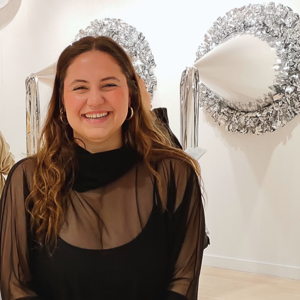
07
Artist Portrait
If you had unlimited time and resources, what project would you most want to realize? What would it mean to you?
There are many things I would want to prioritise before art - ensuring safe housing for women and children, supporting victims of domestic violence, or creating systems of care and advocacy for survivors navigating courtrooms.

But artistically, I’m fascinated by the idea of creating a giant semi-translucent ball that jiggles and shifts as people move around it. I’m interested in the moment where viewers stop looking at the object itself and begin looking at each other through it. The focus shifts toward movement, distortion, sensuality, and the instability of perception.

I’m curious about the way something playful or seductive can completely alter bodily awareness and social behaviour within a space.
< Back
08
Cracks in the weight of me (I-IV)
2024
Ink, paper (monoprint)
22" x 30" (each)
Many of your works seem to borrow from the visual language of parties, consumer objects, and Pop-like sculpture, but they do not remain celebratory or decorative.

The objects become enlarged, isolated, and strangely bodily. How do you think about this tension between seductive commercial surfaces and the more vulnerable or traumatic histories that your sculptures carry?
I’m interested in the way seductive surfaces can disarm people. Commercial aesthetics, party imagery, inflated objects, glossy textures - these visual languages are designed to attract us, to feel familiar, pleasurable, and safe. I use those associations deliberately.

But once someone enters the work more fully, the body begins to emerge within it. The objects stop functioning as decorative or celebratory forms and instead become vulnerable, swollen, leaking, restrained, or exposed. I’m interested in that instability - the point where attraction shifts into discomfort, or where humour and sensuality begin carrying something much heavier beneath them.

I think trauma often operates in exactly that way. It hides itself within ordinary surfaces, within consumer culture, within performance, pleasure, and social rituals. The work attempts to hold those contradictions simultaneously rather than resolving them.
< Back
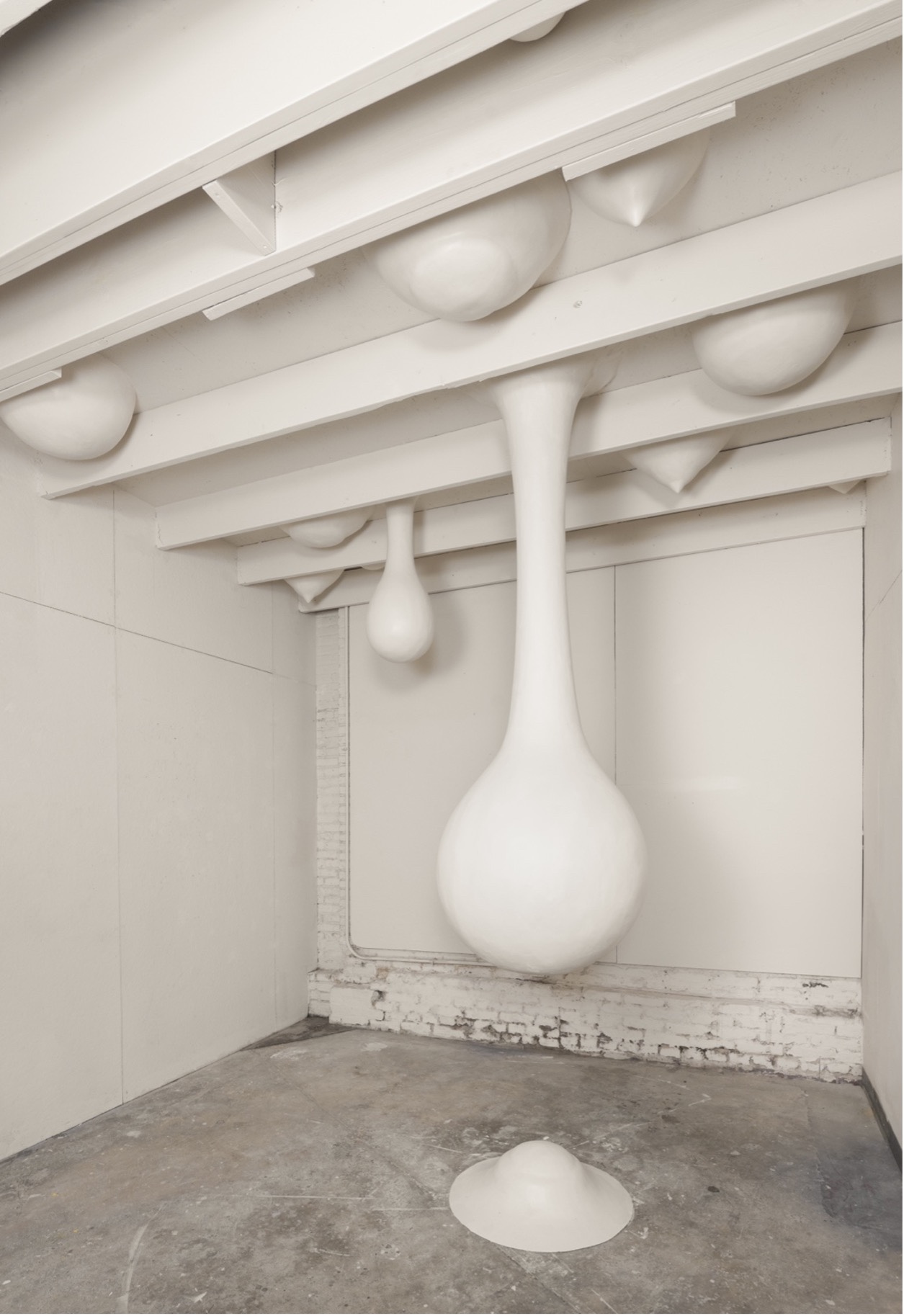
09
Can you feel me
2025
Wood, metal, foam, plaster, paint
Dimensions variable
In some of your installations, the work seems to create passages, links, or channels between different surfaces in the space, such as the floor, wall, ceiling, and architectural edges.

These sculptural gestures give the work a strong visual volume, almost as if the space itself is leaking, breathing, or under pressure.

How do you think about the relationship between sculpture and architecture in your work? Is this spatial expansion a form of release, exposure, or bodily pressure?
I think about architecture as something bodily - something capable of holding pressure, rupture, vulnerability, and containment. Many of my works operate almost like fabricated openings or artificial wounds within a space. They leak, stretch, sag, or press against architecture in ways that make the room itself feel unstable or alive.

I’m very influenced by ideas of deferred maintenance, particularly the way neglected systems continue functioning while quietly accumulating pressure beneath the surface. That tension feels deeply connected to the body and to trauma for me: the effort of holding something together while evidence of strain slowly emerges through cracks, swelling, or collapse.

So the spatial expansion in the work is never only formal. It can feel like release, exposure, bodily pressure, or even contamination. I want the architecture and sculpture to behave as though they are affecting one another physically.
< Back
10
I wave to you, so you see me
2025
Motor, yarn, felt, wood
60" x 60"x 28''
Some of your smaller-scale works and sculptural gestures seem to function differently from your larger installations, operating more intimately or fragmentarily. How do these quieter works relate to your broader sculptural language?
I don’t really see the smaller works as separate from the installations. To me, they function almost like concentrated fragments of the same bodily language. The larger installations tend to operate through immersion and spatial pressure - they affect the viewer through movement, scale, architecture, and physical proximity. The quieter works compress those same tensions into something more intimate and psychologically focused.

I’m interested in fragmentation because memory and bodily experience rarely exist as complete narratives. They appear in flashes, textures, sensations, partial images, or repeated gestures. The smaller works often hold that kind of fragmented intensity. They can feel more restrained or suspended, but I think they carry the same pressure as the larger pieces.

Scale also changes the relationship between the viewer and the object. A monumental work can overwhelm the body, while a smaller gesture can pull someone closer, forcing a more private or attentive encounter. I’m interested in how intimacy can sometimes become more uncomfortable than spectacle.

Even in quieter works, I still think sculpturally about tension, bodily projection, containment, and material behaviour. I want surfaces to feel as though they are holding something - pressure, memory, softness, leakage, restraint. So although the scale changes, the underlying language remains consistent. They are all attempting to negotiate the unstable relationship between bodies, objects, and space.
Brooklyn, NY
Menu
Contact us
Newsletter
Thank you! Your submission has been received!
Oops! Something went wrong while submitting the form.
© 2026 Rexhibit. All rights reserved.
Contact us
Newsletter
Thank you! Your submission has been received!
Oops! Something went wrong while submitting the form.
© 2026 Rexhibit. All rights reserved.