For the best experience, please rotate your phone or switch to a larger screen.

Horizontal viewing is recommended for full access to this section.

IChin Sung
Interview
< Back
Bio   +
Contact   +
01 Was there a defining moment or specific event that made you seriously think about the meaning of making art?
03When you encounter material limitations or technical challenges, how do you usually respond or adapt?
05For those who have never experienced your work before, what do you most hope they see or feel? and why?
07If you had unlimited time and resources, what project would you most want to realize?What would it mean to you?
09Your work often feels spiritual, but not necessarily religious in a strict sense. Thesmoke-like forms, ash surfaces, and energetic gestures seem to materialize attention,intention, and emotional transformation rather than illustrate a specific belief system.

How do you understand the difference between religion, spirituality, and meditativeawareness in your practice?
02 How do you balance rational thinking and intuitive expression in your creative process?
04Do you mind if viewers interpret your work differently from your original intention? In your opinion, does the artwork belong to the audience once it is completed?
06 Have your personal life experiences, such as geography, culture, family, or education, influenced your practice? Could you share an example?
08Your work draws heavily from Taiwanese temple culture, Buddhist ritual, and materialssuch as incense ash. But these works are being made within the context of New York, farfrom the original sites of those rituals.

How does this distance affect the meaning ofthese materials for you?

Do they remain connected to religious practice, or do theybecome a way to negotiate memory, migration, and identity?
10Your practice is influenced by Buddhist ideas such as impermanence, cyclicalbecoming, and non-attachment, yet you work with materials that hold traces of what hasalready passed: incense ash, soil, pigment, residue, and layered surfaces.

When you collect and transform these remains into physical works, do you see the process as away of letting go, or as a way of preserving what would otherwise disappear?
< Back
01
The Last Glance
2026
Metallic paint pen, filler, cotton thread, oil, pencil,
gouache, pastel, and incense ash on panel
6.3 x 7.05 in
Was there a defining moment or specific event that made you seriously think about the meaning of making art?
I feel like there have been several moments in my life when I found myself rethinking the meaning of making art.

The first was when I was working as a designer. Around that time, several of my artist friends were having solo exhibitions, and I remember feeling a mixture of emotions. Although both design and art are creative practices, commercial design is often shaped by market demands and client expectations. That experience made me realize that, more than creating work in service of others, I wanted to use creative practice as a way to express my own voice and perspective.

The second major turning point came after I moved to New York. In the early stages of my artistic practice, I was often preoccupied with producing work quickly and creating visually striking images. I was constantly thinking about how to make work that would immediately capture attention. That mindset began to shift during a class at SVA, where a professor organized visits to a number of artists’ studios. Seeing the diverse ways artists lived and worked had a profound impact on me.

One artist who particularly stayed with me was Serena Chang. Her work draws from her family’s textile factory and her experiences growing up in her hometown. She transformed stockings produced by her family’s factory into sculptural sugarcane installations. I was deeply moved not only by the conceptual framework behind the work, but also by the intimate connection between her personal history and material choices. That encounter prompted me to reconsider the purpose of my own practice and encouraged me to return to material experimentation in a more meaningful way.

For me, the meaning of making art lies in continually questioning my own inner world while creating opportunities for deep, emotional connections with others. Art becomes a space where both the artist and the viewer can engage in a kind of soul-to-soul conversation.
< Back
02
Farewell
2026
Metallic paint pen, magnet, charcoal pencil, oil, pencil,
gouache, pastel, and incense ash on panel
10.2 x 12 in
How do you balance rational thinking and intuitive expression in your creative process?
Honestly, I’m a very intuition-driven artist. If I rely only on instinct, though, my work can start to feel a little loose or unfocused.

So I’ve developed a way of giving myself a broader framework before I begin. I often make something like a mind map with keywords, themes, or color palettes that relate to the direction I want to explore. Those elements act as anchors, but I still allow myself to respond intuitively while making the work.

In practice, the structure is rational, but the process inside it is intuitive. That balance helps me stay open and spontaneous without losing coherence in the work.
< Back
03
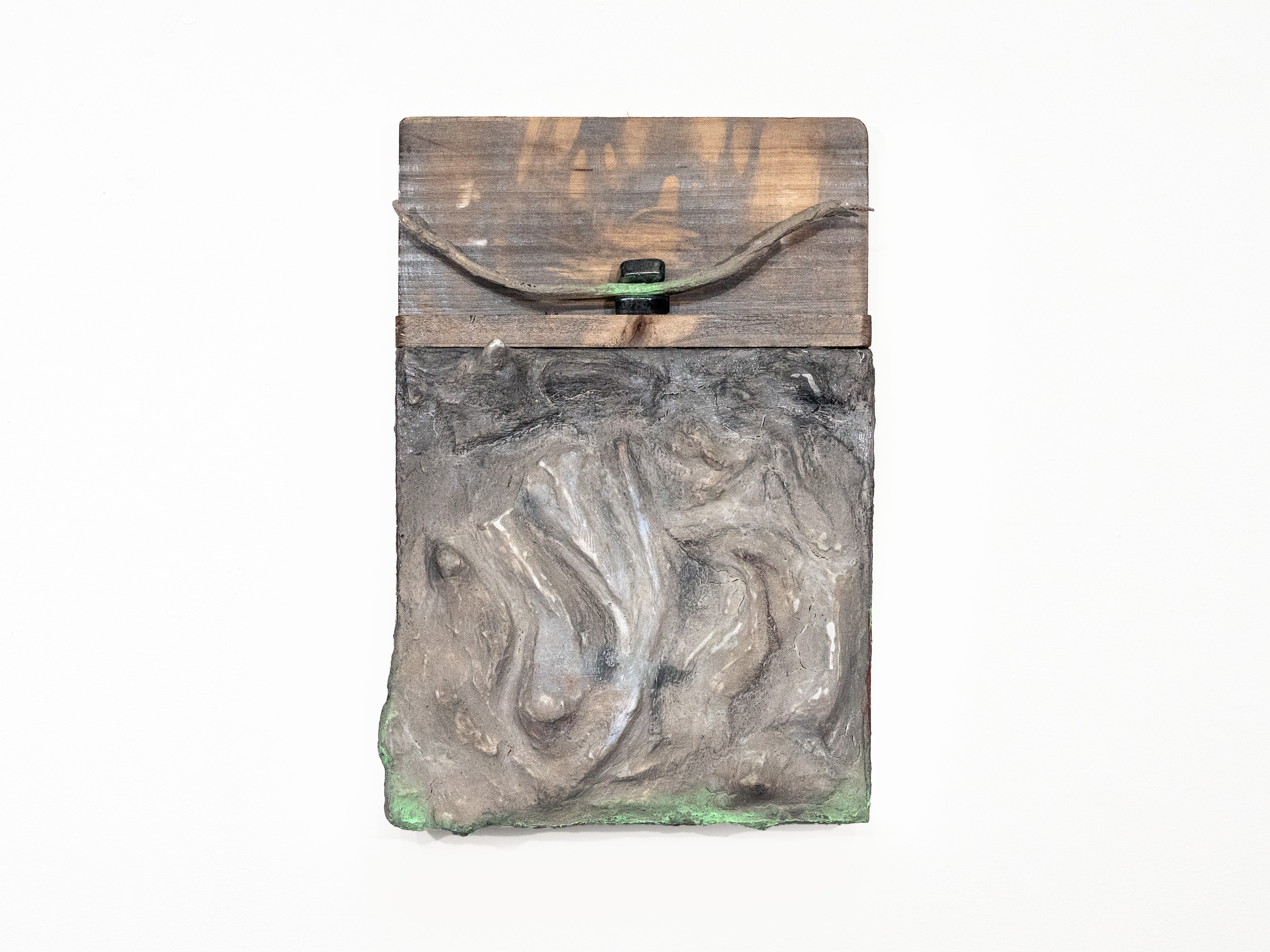
Suffocation
2026
Pencil, twig, charcoal pencil, magnet, wooden frame,
pastels, clay, and incense ash panel
12.2 x 8.1 in
When you encounter material limitations or technical challenges, how do you usually respond or adapt?
When I encounter technical challenges, my first instinct is to seek advice from people with specialized knowledge or to learn the technique myself. I enjoy treating obstacles as opportunities to expand my understanding of materials and processes.

For example, during some of my material experiments, I worked extensively with products from Golden Artist Colors. When I was unsure whether certain materials I was testing would be compatible with their products, I reached out directly to the company and consulted their technical team. They were able to answer my questions and provide guidance on how to use the materials safely and effectively.

When it comes to limitations in resources, I try to approach the situation pragmatically. I ask myself whether I truly need a particular material, tool, or opportunity at that moment, and if not, I look for alternative solutions. In many cases, constraints can actually encourage creativity and lead me to discover new approaches that I might not have considered otherwise.
< Back
04
T-axis: the entrance/clock of the ghost’s room
Sap of the lacquer tree, fake glit, brass, MDF, OHP film, spray paint, clock movements, resin and mixed media
114.2 x 35.4 x 23.6 inches, 290 x 90 x 60 cm
2022
Do you mind if viewers interpret your work differently from your original intention? In your opinion, does the artwork belong to the audience once it is completed?
My work is an epistemological exploration that often engages with myth, ritual, and systems of belief—so I consider different interpretations not only inevitable, but essential. Observing how viewers respond, especially when their reactions diverge based on personal backgrounds such as religious belief or cultural experience, allows me to understand how visual language resonates across boundaries. For instance, when a work draws from sacred spatial structures, those with religious affiliations often respond very differently from those without. I find these moments of contrast generative—they often inform the conceptual direction of future works.

Once the work is completed and presented in an exhibition, I see it as a shared encounter. The audience brings their own world to the work, just as I brought mine. Rather than believing that the artwork belongs solely to the artist or to the viewer, I see it as a site of exchange—where worlds overlap, interpretations multiply, and new meanings emerge through engagement.
< Back
05
Awakening the Mind
2026
incense ash on origami lotus flowers, mirror paper,
clay, pastel, and incense ash on panel
12.7 x 6.55 in
For those who have never experienced your work before, what do you most hope they see or feel? and why?
More than anything, I hope they feel a quiet but powerful force within the work. something that appears calm on the surface yet contains intense emotional currents underneath.

Many of my works are rooted in experiences of grief, longing, memory, and transformation. These emotions are often not expressed through dramatic gestures, but rather through subtle shifts, accumulated traces, and layered materials. I hope viewers can sense that tension between stillness and turbulence, between what is visible and what remains hidden.

If that feeling can draw them into a deeper engagement with the work, then it opens a space for reflection, not only on my experiences, but also on their own. For me, art is most meaningful when it creates a connection that goes beyond visual appreciation and invites a more personal and emotional encounter.
< Back
06
Impermanence
2026
Oil pastels, foam, clay, origami lotus flowers, mirror paper,
crystals filtered from incense ash, origami lotus flowers,
incense ash, and modeling paste on canvas
90.4 x 83.4 x 63.6 in
Have your personal life experiences, such as geography, culture, family, or education, influenced your practice? Could you share an example?
Absolutely. My practice is deeply shaped by the cultural and familial experiences I grew up with in Taiwan.

Taiwan has a unique religious landscape formed through the blending of Taoism, Mahayana Buddhism, and local folk beliefs. Many people embrace a highly inclusive approach to spirituality. There is a common saying that roughly translates to, “If there is a deity, we pay our respects; if we pray, we may receive blessings.” As a result, it is common to see Buddhist and Taoist figures, such as Guanyin, Mazu, and the Earth God, worshipped within the same temple. Temples are woven into everyday life and can be found throughout cities, towns, and neighborhoods across Taiwan.

My connection to these traditions, however, comes primarily through family experience. Throughout my childhood, I frequently accompanied my family to funerals and Buddhist chanting ceremonies held in remembrance of deceased relatives. Rather than praying to deities for protection or prosperity, my family often turned to Buddhist rituals as a way of maintaining a connection with loved ones who had passed away.

Because of this, the act of holding incense and standing before the altar became an important part of my memory. For my father in particular, honoring my grandparents was a deeply meaningful responsibility. Beyond annual occasions such as Tomb-Sweeping Day, we would also visit temples on their birthdays and death anniversaries to pay our respects.
Absolutely. My practice is deeply shaped by the cultural and familial experiences I grew up with in Taiwan.

Taiwan has a unique religious landscape formed through the blending of Taoism, Mahayana Buddhism, and local folk beliefs. Many people embrace a highly inclusive approach to spirituality. There is a common saying that roughly translates to, “If there is a deity, we pay our respects; if we pray, we may receive blessings.” As a result, it is common to see Buddhist and Taoist figures, such as Guanyin, Mazu, and the Earth God, worshipped within the same temple. Temples are woven into everyday life and can be found throughout cities, towns, and neighborhoods across Taiwan.

My connection to these traditions, however, comes primarily through family experience. Throughout my childhood, I frequently accompanied my family to funerals and Buddhist chanting ceremonies held in remembrance of deceased relatives. Rather than praying to deities for protection or prosperity, my family often turned to Buddhist rituals as a way of maintaining a connection with loved ones who had passed away.

Because of this, the act of holding incense and standing before the altar became an important part of my memory. For my father in particular, honoring my grandparents was a deeply meaningful responsibility. Beyond annual occasions such as Tomb-Sweeping Day, we would also visit temples on their birthdays and death anniversaries to pay our respects.
< Back
07
Artist Portrait
If you had unlimited time and resources, what project would you most want to realize? What would it mean to you?
If I had unlimited time and resources……I would love to travel around the world~~

Life is relatively short, perhaps only sixty to eighty years, and none of us knows what comes next. Because of that, I feel a strong desire to make the most of my time here by exploring places, cultures, and experiences beyond those I already know.

For me, travel is not simply about seeing new landscapes. It is a way of encountering different ways of living, believing, remembering, and understanding the world. Every place carries its own histories, rituals, and emotional textures, and I am deeply curious about how people across cultures make meaning of life, loss, and connection.

If I had unlimited resources, I would dedicate myself to a long-term journey of exploration, visiting places I have never been, learning from different communities, and immersing myself in unfamiliar environments. I believe those experiences would become invaluable nourishment for my artistic practice.

Ultimately, the project would not just be about traveling the world; it would be about expanding my understanding of humanity and bringing those discoveries back into my work.
< Back
08
Artist Portrait
Your work draws heavily from Taiwanese temple culture, Buddhist ritual, and materials such as incense ash. But these works are being made within the context of New York, farm from the original sites of those rituals.

How does this distance affect the meaning of these materials for you?

Do they remain connected to religious practice, or do they become a way to negotiate memory, migration, and identity?
The incense ash I use is not collected in Taiwan, but from a Buddhist temple in Manhattan's Chinatown. When I visit these temples, I often find myself deeply moved by the memorial tablets lining the walls, each bearing the name of someone who has passed away.

Standing in those spaces, I cannot help but think about the generations of immigrants whose lives are embedded there, the stories of grandparents who left their homelands, built new lives in New York, and eventually passed away far from where they were born. Their descendants continue to visit these temples to honor their ancestors, maintaining traditions of remembrance across generations and geographic distances.

Although these temples are far from Taiwan, the atmosphere feels surprisingly familiar. They remind me of the temples I visited with my family while growing up and of the rituals through which we maintained connections with deceased relatives. In that sense, the distance does not sever the meaning of these materials; rather, it transforms and expands it.

For me, incense ash remains connected to religious practice, but it also carries broader meanings related to memory, migration, and belonging. It embodies the prayers, hopes, and acts of devotion of countless individuals. At the same time, it contains traces of my own experiences, moments when I stood before an altar, communicating with family members who had passed away.

By incorporating incense ash into my work, I am interested in how a material can function as both a spiritual residue and a cultural archive. It becomes a way of thinking about what travels across borders, what remains after displacement, and how personal and collective memories continue to persist through ritual. Through these works, I am not only reflecting on religious traditions but also exploring how identity is shaped by movement, inheritance, and the emotional ties that connect us to people and places across time and distance.
< Back
09
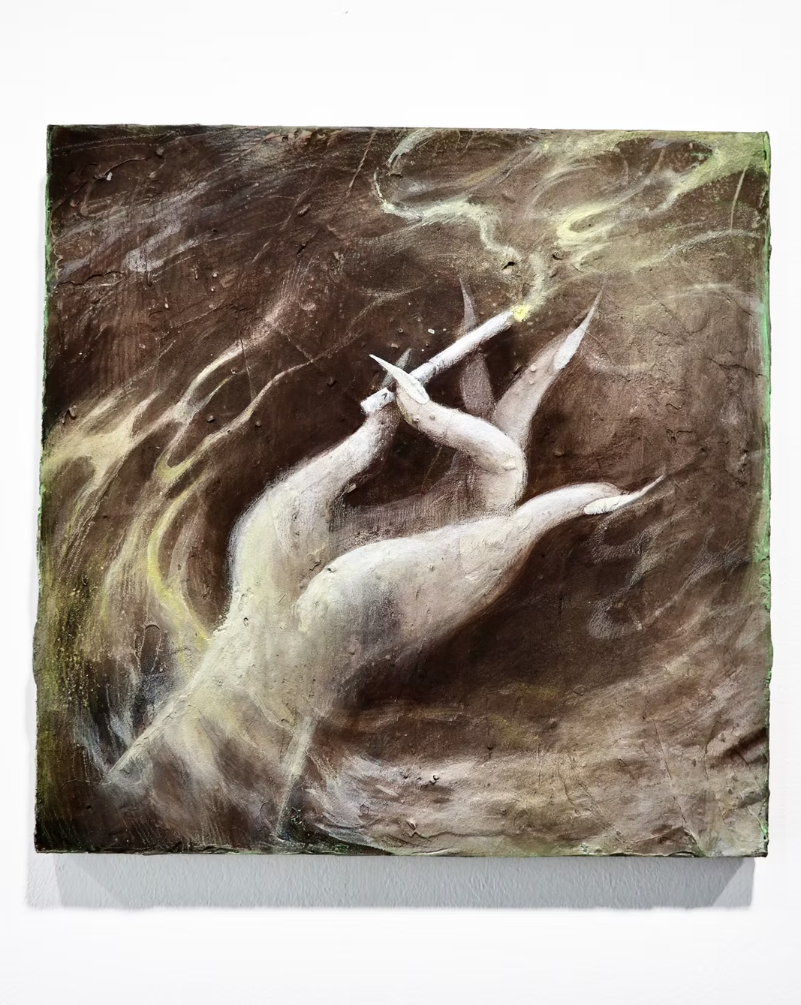
A Private Ritual
2026
Incense ash, gouache, acrylic, colored pencils, and pastels on wood panel
12 x 12 in
Your work often feels spiritual, but not necessarily religious in a strict sense.

The smoke-like forms, ash surfaces, and energetic gestures seem to materialize attention, intention, and emotional transformation rather than illustrate a specific belief system.

How do you understand the difference between religion, spirituality, and meditative awareness in your practice?
For me, religion, spirituality, and meditative awareness are related but distinct concepts.

I see religion as an organized system of beliefs, rituals, and ethical teachings that provides a framework for understanding life and our relationship to the world. Spirituality, on the other hand, is more personal. It is an individual's search for meaning, connection, and a deeper understanding of existence. Meditation is a practice that trains attention and awareness, cultivating clarity, presence, and inner calm. Although meditation has roots in many religious traditions, it is now widely practiced beyond religious contexts as a tool for self-reflection and mental well-being.

The smoke-like forms, layered surfaces, and repetitive gestures in my work are closely connected to a meditative way of making. Through the process of working with materials, I enter a state of focused attention that allows me to reflect on grief, longing, impermanence, and personal experience. In this sense, spirituality in my work is not about promoting a particular belief system, but about creating space for awareness, reflection, and emotional connection.

Ultimately, I hope the work invites viewers into a similar experience—one that is open-ended and contemplative, regardless of their religious background or personal beliefs.
< Back
10
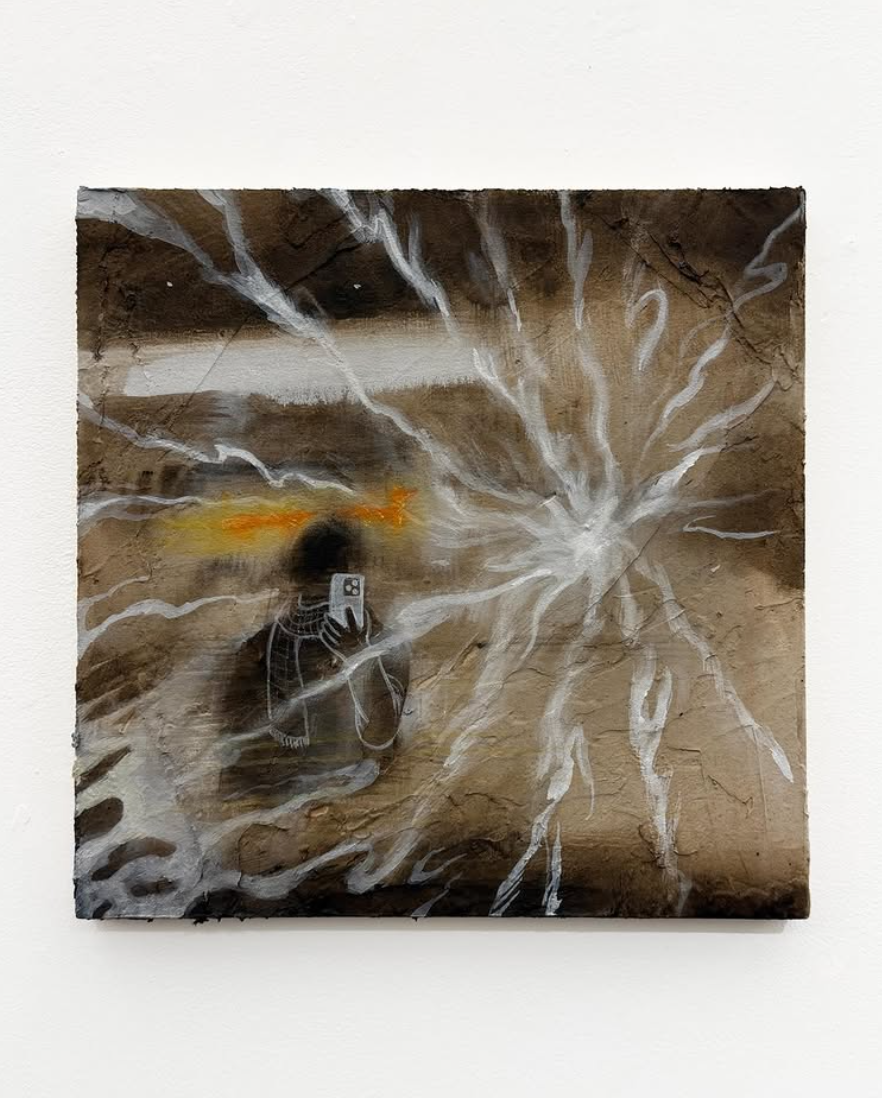
Where Memory Pauses
2026
Acrylic and incense ash on panel
12 x 12 in
Your practice is influenced by Buddhist ideas such as impermanence, cyclical
becoming, and non-attachment, yet you work with materials that hold traces of what has already passed: incense ash, soil, pigment, residue, and layered surfaces.

When you collect and transform these remains into physical works, do you see the process as a
way of letting go, or as a way of preserving what would otherwise disappear?
The figures I paint are often connected to people I can no longer meet in this life. They include deceased family members, as well as memories of past relationships that have ended but remain emotionally unresolved. At the beginning, my practice was driven by a desire to understand why certain attachments are so difficult to let go of. Painting became a way for me to register and give form to these emotions.

As mentioned in the previous question, I see incense ash as a material that carries the beliefs, wishes, and emotional projections of many people. It is already a residue of devotion and memory. When I incorporate it into my work, it holds multiple temporalities at once.

For me, this process contains a dual meaning. On one hand, it functions as a way of letting go, an attempt to externalize and release emotions that are difficult to hold internally. On the other hand, it also becomes a form of preservation, where those very emotions, memories, and experiences are recorded and embedded within the material.
Brooklyn, NY
Menu
Contact us
Newsletter
Thank you! Your submission has been received!
Oops! Something went wrong while submitting the form.
© 2026 Rexhibit. All rights reserved.
Contact us
Newsletter
Thank you! Your submission has been received!
Oops! Something went wrong while submitting the form.
© 2026 Rexhibit. All rights reserved.