For the best experience, please rotate your phone or switch to a larger screen.
‍
Horizontal viewing is recommended for full access to this section.

Teresa Guadalupe Olds
Interview
< Back
Bio   +
Contact   +
01 Was there a defining moment or specific event that made you seriously think about the meaning of making art?
03When you encounter material limitations or technical challenges, how do you usually respond or adapt?
05For those who have never experienced your work before, what do you most hope they see or feel? and why?
07If you had unlimited time and resources, what project would you most want to realize?What would it mean to you?
09Your paintings move between architectural spaces, portraits, and scenes that suggest particular memories or narratives. The architectural works, however, seem to leave more room for interpretation, allowing shapes, colors, and the physical handling of paint to carry emotional and symbolic weight without relying on a recognizable story.

What draws you to this less literal form of expression, and how do you understand the relationship between these different visual approaches in developing your own artistic language?
02 How do you balance rational thinking and intuitive expression in your creative process?
04Do you mind if viewers interpret your work differently from your original intention? In your opinion, does the artwork belong to the audience once it is completed?
06 Have your personal life experiences, such as geography, culture, family, or education, influenced your practice? Could you share an example?
08Your decision to move away from photographic references seems closely tied to reclaiming your own way of seeing and understanding reality.

Yet photography itself can also challenge dominant ways of seeing, as demonstrated by Will Wilson’s Critical Indigenous PhotographicExchange, which reexamines colonial representations through collaborative portraiture. What specifically felt limiting about photographic references in your practice, and how has moving beyond them changed the way you construct and communicate your own sense of reality through painting?
10In Pappy’s Waiting Room, you return to architectural forms that appeared in The Waiting Room, now in the context of remembering your father.

While these works emerged from different moments in your life, they seem to share a visual language that has taken on new emotional significance.Has creating the later work changed the way you understand the earlier one?

More broadly, do you feel that the meaning of an artwork can continue to evolve alongside the artist’s own life and experiences?
< Back
01
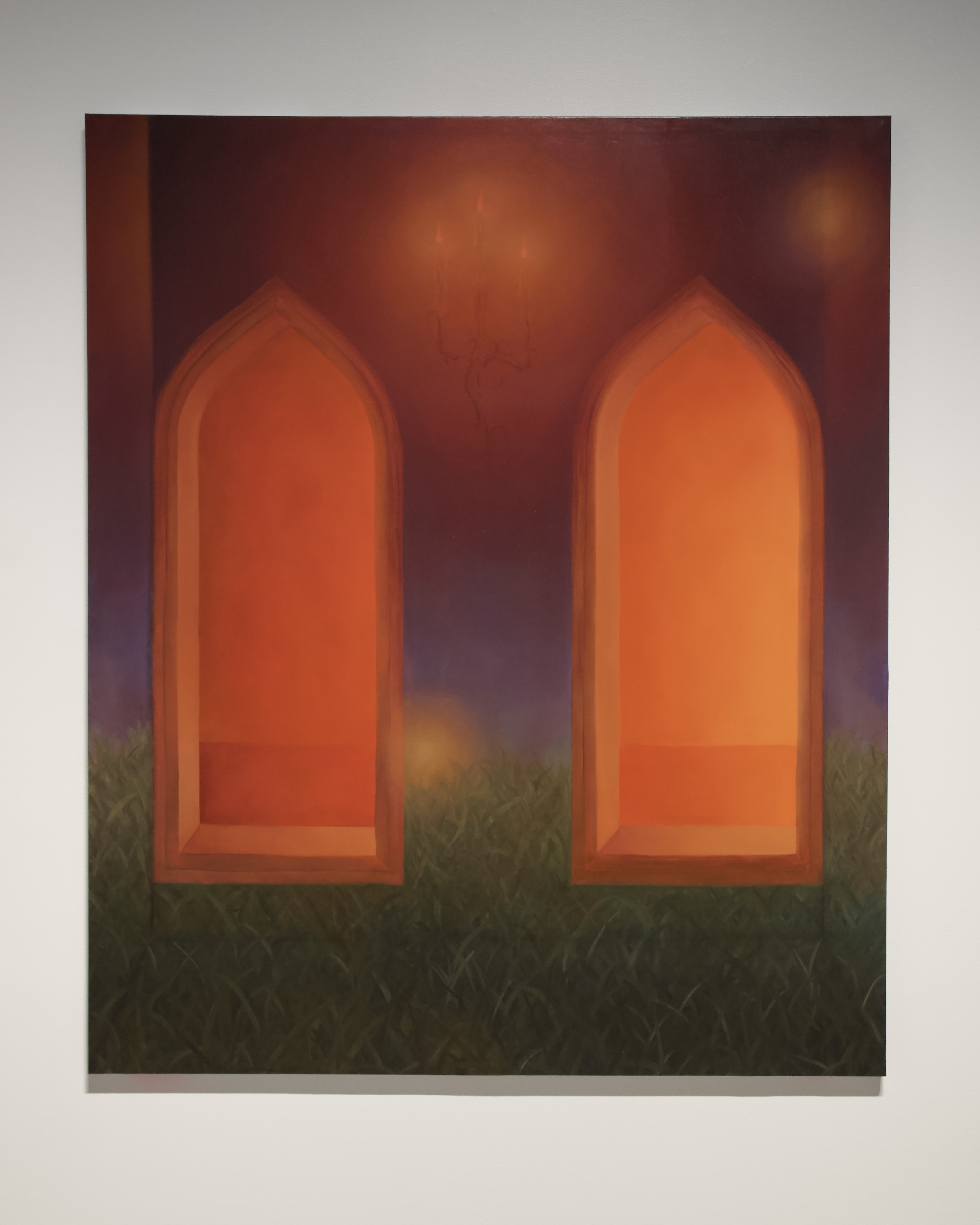
The Waiting Room
2025
Oil on canvas
72 × 84 in
Was there a defining moment or specific event that made you seriously think about the meaning of making art?
I think my relationship to making art really changed during grad school, when I began to realize that I had been hiding behind my work rather than using it to understand myself. I had a lot of experiences within my life that I had never really given myself the space to unpack, and making art became a way for those things to naturally surface. I became interested in what happened when I made art without a specific motive or the pressure of trying to make something “good.” I noticed that the work often became like an encrypted file of my own personhood, revealing things about myself that I hadn’t consciously recognized. Certain symbols, images, and environments would keep resurfacing, and through making, I could begin to understand why I was holding onto them. Painting became a way of having a conversation with myself, untangling experiences and feelings that I hadn’t fully processed. It shifted my understanding of art from simply making an image to creating a space where I could discover something about myself.
< Back
02
The Waiting Room ll
2025
Oil on wood
16 x 24 in
How do you balance rational thinking and intuitive expression in your creative process?
Pablo Picasso once said, “It took me four years to paint like Raphael, but a lifetime to paint like a child,” and I think about that a lot. I think one of the hardest parts of making art is learning how to get out of your own way. There’s a certain point where having the technical knowledge to make a painting work can actually become a barrier to making something that feels instinctive and true to you. I tend to think of a painting as an equation, where every decision affects the balance of the whole image. Some things fall into place naturally, while others can throw everything off. There’s a rational process involved in figuring out what makes a painting work, but at the same time, I have to leave room for things that might not make sense logically, to follow an impulse without immediately questioning it. I think painting is a lot like dancing. You’re constantly making adjustments, but there’s a point where you find a rhythm and stop consciously thinking about every movement. I’m always trying to find that sweet spot where the structure is there, but it doesn’t interfere with the freedom of expression.
< Back
03
La Luz (study)
2025
Oil on canvas
10 x 16 In
When you encounter material limitations or technical challenges, how do you usually respond or adapt?
I think material limitations and technical challenges often push me outside the boundaries of what I’m comfortable with, and that can open up entirely new directions in my practice. Last year, for example, I wanted to create an installation even though my background was primarily in painting. I had very little experience with sound design or video, but by experimenting with those mediums, I was able to create an experience that evoked a very potent and specific feeling in people that I hadn’t been able to achieve through painting alone.
‍
I think of different materials as different elements I can use to build a world. Sometimes the medium you’re working with isn’t necessarily the best vehicle for what you’re trying to communicate, and exploring something unfamiliar can reveal a much more natural way to get there. There’s also a certain freedom in not knowing what you’re doing yet. When you’re a beginner, you don’t have the same expectations of yourself, so you can let go of the pressure to get everything right and approach the process with more playfulness and curiosity. I think some of the most interesting discoveries happen when I’m willing to experiment without knowing exactly where I’ll end up.
< Back
04
Pappy’s Waiting Room
2026
Oil on linen
32 x 50 In
Do you mind if viewers interpret your work differently from your original intention? In your opinion, does the artwork belong to the audience once it is completed?
I definitely believe that the work belongs to the audience once it’s completed, and I don’t mind when people interpret it differently from how I originally intended. I think that’s one of the most rewarding parts of making art. You never know how someone might relate to something deeply personal to you, or what it might evoke in their own imagination or allow them to recognize about themselves.
‍
I once had a friend tell me that she was always surprised by my work because, in person, I’m a pretty happy and extroverted person, but my paintings seemed to reveal a deeper sadness or intensity that she wouldn’t necessarily associate with me. The work can communicate parts of my inner world that aren’t necessarily apparent, or that I might never speak about. Regardless of how someone interprets it, I feel that something meaningful has already happened in the act of putting that part of myself out there while communicating things I might not know how to express any other way, so there's something beautiful about being seen, even if not necessarily understood.
< Back
05
La Shamana
2024
Oil on canvas
42 x 56 In
For those who have never experienced your work before, what do you most hope they see or feel? and why?
I think I would want people to come away from my work with a sense of the magic and mythology that can exist in everyday life, even within experiences of pain and suffering. I’ve always been interested in personal mythology and the idea that we can reclaim our own experiences by shaping them into a narrative that makes sense to us. A lot of my work draws from difficult or traumatic experiences, but I often depict them through intensely colorful, almost fantastical imagery. I’m less interested in recreating exactly what happened than in capturing how an experience registered within me, because I think that subjective reality can be just as meaningful, if not more so, than the literal events themselves.
‍
That same idea extends to seemingly ordinary moments, too. In one painting, I depicted my dad’s old car parked outside our family home in Florida. The original photograph was taken over a decade ago on an ordinary, gloomy day, but when I returned to that memory years later, it had taken on a completely different significance. I painted the scene with a brilliant blue sky, luminous green grass, and sunlight reflecting off the car, because that was how the memory felt to me looking back. I think I want people to consider how the meaning of an experience can change over time, and how something that once seemed mundane, or even painful, can eventually become meaningful in ways we couldn’t have anticipated.
< Back
06
Studio Portrait 1
‍
Have your personal life experiences, such as geography, culture, family, or education, influenced your practice? Could you share an example?
My personal experiences have had a huge influence on my practice, particularly my relationship to my Mexican roots and spirituality. Growing up in predominantly white spaces in the United States, I often felt like these parts of my life belonged to a completely different world from the one I was navigating day to day. I kept that side of myself separate, and it wasn’t until my MFA that I began questioning why I had never really allowed it into my work.

I started revisiting experiences that had profoundly shaped me, including an intense, transformative ayahuasca ceremony in Mexico when I was 17, alongside the spiritual beliefs and traditions I grew up around through my family. Exploring these experiences opened up questions about how we understand reality and how something can be meaningful even when it falls outside what we can easily explain. I became interested in how to give visual form to experiences that don’t have an obvious reference in the physical world, or that are difficult to articulate through language. I’ve always been drawn to the presence of spirituality and the supernatural in Mexican culture, from Catholic imagery to folklore about spirits, monsters, and otherworldly beings. I think this also informs my interest in personal mythology, which has been shaped in part by reading Carlos Castaneda’s Don Juan books. I’m drawn to the way these books blur the boundaries between the ordinary and the extraordinary, and question whether an experience needs to be objectively verifiable to hold meaning. That influence comes through in my paintings’ dreamlike environments, spiritual symbolism, and fantastical imagery that often exists just one step away from reality.
< Back
07
Studio Portrait 2
‍
If you had unlimited time and resources, what project would you most want to realize? What would it mean to you?
I’ve always wanted to make a full-length film that draws on my own experiences but reimagines them through a surrealist lens. I love the idea of having an entire storyline to build a world around, with its own atmosphere, characters, music, and visual language. Something that begins in a reality people recognize but gradually moves into the fantastical, where spirituality, mythology, and the strange things that make up our inner lives can exist alongside the everyday. It wouldn’t be autobiographical in a literal sense, but it would carry the emotional truth of my experiences.

This is part of why I love Carlos Castaneda’s Don Juan series so much. I love that people still debate whether the events actually happened, whether Don Juan was a real person, or whether any of it could be possible. I’m drawn to that ambiguity, where you don’t have to settle the question of what’s real and what’s imagined. I want to explore that space in my own work and let someone experience it through a story, sound, and moving images, rather than asking them to take it in through a single frame.

I think my desire to make art has always been tied to wanting to be seen in a deeper way that goes beyond how people know me in everyday life. I wouldn’t need the story to be a literal account of my life, or for someone to interpret it exactly as I intended. I’d want them to spend time inside a world shaped by my experiences and imagination, and to have their own experience of it. For me, that would be a way of sharing something deeply personal without having to reduce it to a story about myself.
< Back
08
2015
2026
Oil on canvas
18 x 24 In
Your decision to move away from photographic references seems closely tied to reclaiming your own way of seeing and understanding reality. Yet photography itself can also challenge dominant ways of seeing, as demonstrated by Will Wilson’s Critical Indigenous PhotographicExchange, which reexamines colonial representations through collaborative portraiture. What specifically felt limiting about photographic references in your practice, and how has moving beyond them changed the way you construct and communicate your own sense of reality through painting?
For me, the photograph became a metaphor for the external standards of reality and acceptability that I had already internalized and was unconsciously reproducing in my art. It gave me something concrete to work from, a fixed image that could be judged as accurate, aesthetically pleasing, or technically successful. I was looking outward for a version of reality that I could reproduce convincingly, rather than trusting my own experience as a valid starting point. It was only as I began unpacking my practice that I understood how deeply this impulse was connected to the way I had learned to navigate the world. I had spent much of my life concealing major parts of myself that didn’t fit neatly into the environment I grew up in, separating cultural or spiritual aspects of my identity and internal world that felt difficult to reconcile with the person I was expected to be. I began to recognize that I was doing something similar in my paintings, prioritizing what looked right and what could be understood from the outside while suppressing what was actually happening within me.

I don’t think of photography itself as inherently colonial or oppressive, but to me there is a kind of erasure that happens when the surface becomes the whole story. In my own practice, the photograph had become a kind of cage because of the authority I had given it. It represented a way of thinking in which what was visible and verifiable took precedence over what was felt, remembered, or experienced internally. A photograph can document the physical matrix of a moment, but it cannot determine the full meaning of that moment for the person who lived it. I became interested in the space between those two things: the external world we can observe and the individual reality each of us experiences within it. Memory, emotion, imagination, and spirituality are also huge parts of our reality, even when they can’t be verified through an image or easily articulated in words. I wanted those experiences to have the same legitimacy in my paintings as anything I could see in front of me, rather than treating the photograph as the authority and my painting as an interpretation of it. Ultimately, this shift became about reclaiming my own perspective, and with it, the value of my own personhood outside the expectations of the environment I grew up in. I’m not trying to deny what happened or argue against the value of documenting the physical world. I’m questioning why the literal appearance of something should have more authority than the way it is experienced and integrated into our lives.
< Back
09
December
2026
Oil on canvas
12 x 16 In
Your paintings move between architectural spaces, portraits, and scenes that suggest particular memories or narratives. The architectural works, however, seem to leave more room for interpretation, allowing shapes, colors, and the physical handling of paint to carry emotional and symbolic weight without relying on a recognizable story. What draws you to this less literal form of expression, and how do you understand the relationship between these different visual approaches in developing your own artistic language?
The architectural spaces came out of my desire to draw from an experience that had profoundly affected me but was almost impossible to translate visually. I wanted to revisit a life-altering ayahuasca ceremony I had participated in when I was seventeen. Although it was an incredibly intense experience, it wasn’t very visual for me. Nothing about my physical surroundings had changed. The experience was entirely internal, and I knew that trying to create a definitive image to represent it would feel limiting. Instead of trying to illustrate what happened, I wanted to focus on what it felt like. I began stripping the paintings down to their bare bones, using architecture, color, and shape to convey something that didn’t have a clear visual reference.

I think of a room as a container. In dream interpretation, houses and buildings are often understood as representations of one’s consciousness, and I was drawn to the idea of a physical structure holding something psychological or spiritual. The room gave me a consistent framework to work within without requiring me to construct a particular narrative or sequence of events. There’s something inviting about a room that you can step into or feel immersed in, especially when the work is large-scale. Because there’s nothing for your brain to decode or figure out, but the environment itself is so familiar, there’s an invitation for presence and stillness. With my more complex or intricate paintings, there’s often more to unpack, contemplate, or interpret. But when I’m working primarily with light and color, those elements can bypass the need to make sense of something first. You can experience the work without needing to understand it. A lot of my visual language comes from experimenting with how much of an experience needs to be made visible for its emotional reality to come through.
< Back
10
The Nights…(installation view)
2025
video, projection, ceramics
6' 01''
Watch Full Video
In Pappy’s Waiting Room, you return to architectural forms that appeared in The Waiting Room, now in the context of remembering your father. While these works emerged from different moments in your life, they seem to share a visual language that has taken on new emotional significance.Has creating the later work changed the way you understand the earlier one? More broadly, do you feel that the meaning of an artwork can continue to evolve alongside the artist’s own life and experiences?
The Waiting Room began as an attempt to process an experience that had profoundly affected me but that I had never really spoken about or worked through. Over time, I came to understand the room as a kind of threshold, a point of transition where you’re suspended between two states of being. My ayahuasca ceremony was the first major experience I tried to understand through that framework, but the ceremony itself was really a starting point for something more universal: the feeling of standing at the edge of a profound change. In moments like that, time can seem to slow down, and there’s an almost timeless stillness between what was and what comes next.

When my father passed away, I found myself returning to that framework, but with a completely different kind of transition in mind. Rather than focusing solely on what his death meant for me, I wanted to imagine what his own waiting room, his own threshold, might look like as he crossed the greatest threshold of all, between life and death. I wanted to create a piece in which I could imagine that transition in a way that felt comforting to me. Although my father’s death was a deeply sad experience, my personal mythology allows me to imagine it through a different lens, one that can be colorful, natural, and comforting. I realized that the framework I’d developed years earlier could continue to hold experiences as I moved through life, something I never could have anticipated when I first began the series.

I do think the meaning of an artwork can evolve alongside your life, sometimes in ways you couldn’t have planned. I think this is also connected to the way I approach making art intuitively. I’m not always trying to determine what something means before I make it and then find a way to communicate that meaning to someone else. I’m trying to work from a place that feels authentic to me, allowing things to emerge from my subconscious that I might not fully understand at the time. In that sense, a work can be like a seed. Its meaning continues to unfold as I change, and sometimes I only recognize what was already there after life gives me a new way of seeing it.
Brooklyn, NY
Menu
Contact us
Newsletter
Thank you! Your submission has been received!
Oops! Something went wrong while submitting the form.
© 2026 Rexhibit. All rights reserved.
Contact us
Newsletter
Thank you! Your submission has been received!
Oops! Something went wrong while submitting the form.
© 2026 Rexhibit. All rights reserved.