In September 2026, REXHIBIT and MUYAO presented Forms of Attention in Shanghai, bringing together ten artists whose work moves between painting, material processes, images, and space. “Where Perception Becomes Form” was the exhibition’s point of departure: what does attention look like once it becomes part of an artwork? The question continued online in October, when four participating artists spoke about choices made in the studio, memories carried into their work, and problems they were still trying to solve. Their accounts did not add up to one definition. Instead, they made the idea of attention more specific and, in some ways, harder to pin down.
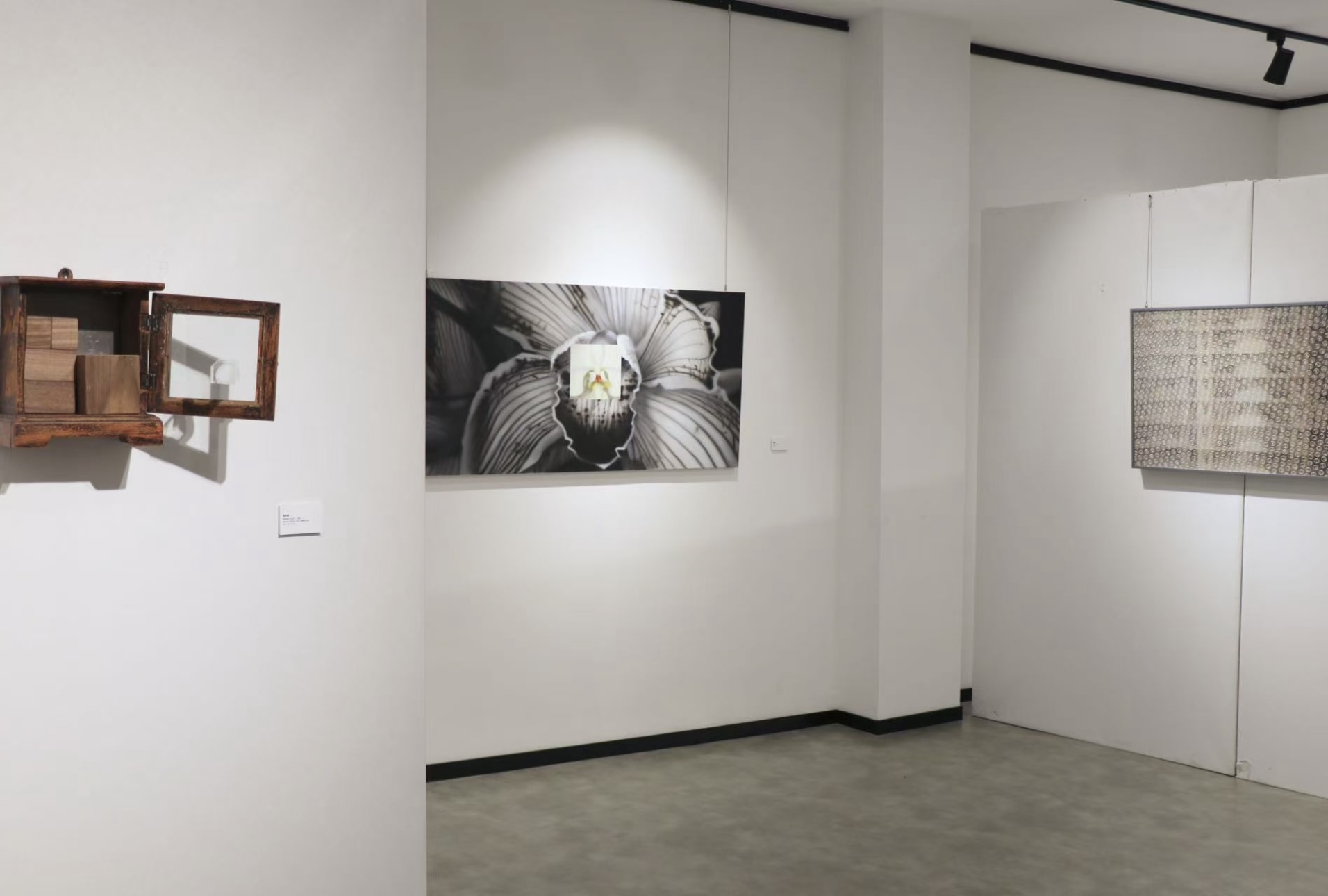
The title grew out of Yuanjie Chen’s experience as an artist. In fields where production can be measured, attention is often inferred from efficiency, error rates, or consistency. Those measures tell us little about art. A hyperrealist painter may spend weeks on a small detail, while a minimalist may leave only a few forms in place. There is no sensible way to rank the attention behind those choices by counting what appears on the surface. An artist’s attention may settle on the resistance of a material, a persistent memory, a bodily experience, or a decision to leave something out. Forms of Attention did not ask its participants to perform the same kind of concentration. It allowed their work to show how differently attention can be directed.
Four Practices, Four Ways of Looking
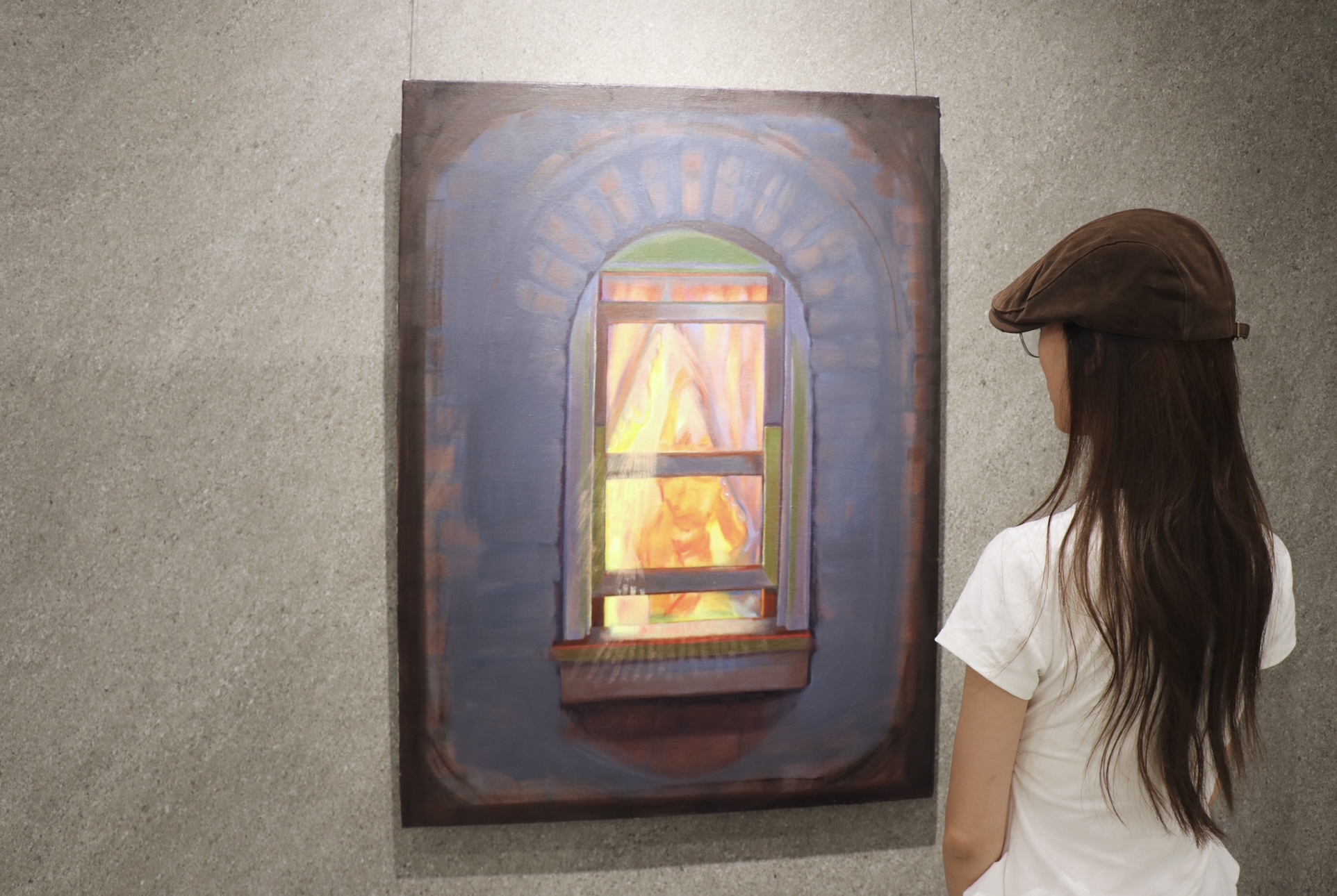
Mimi Pinnow’s Glimpse makes a window both a literal subject and an uncertain point of entry. The painting draws on her observations of New York apartments, architectural details, and miniature spaces. A window limits the view to a frame, yet it also suggests the life that continues beyond it. Color does not simply record a place here; it gives form to the way memory rearranges what was once seen. During the artist talk, Pinnow’s thoughts on architecture and looking helped clarify the work’s spatial concerns. Glimpse is not only a picture of somewhere we might see. It asks how a fragment of a place can become the basis for our sense of that place.
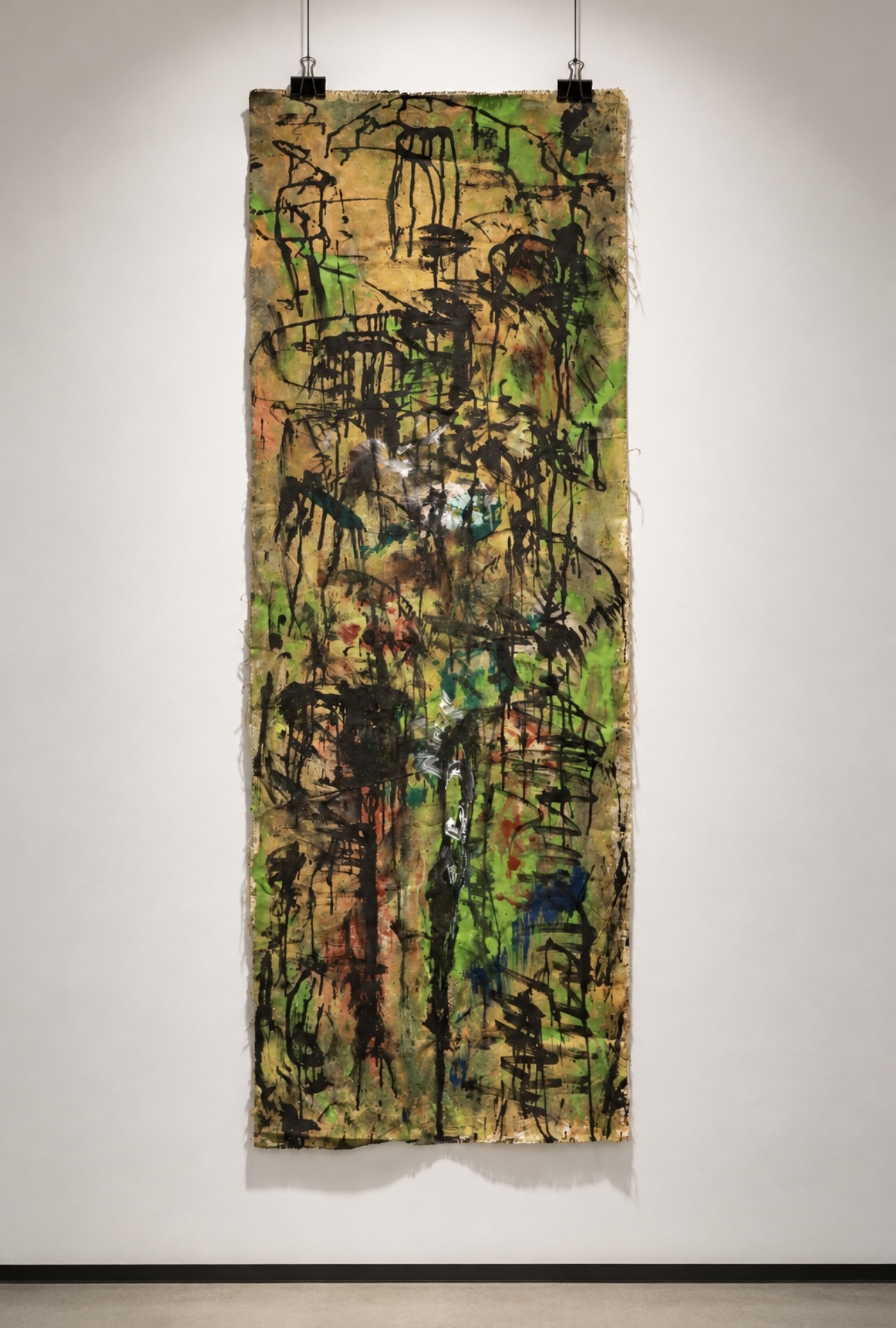
Gaëlle Solange Étémé works from another form of attention, one grounded in material and bodily action. In The Etymology of the Form, an old canvas, turmeric, and traces of paint produce a language somewhere between writing and image. The work does not always move toward a figure decided in advance. Sometimes a face becomes recognizable only after the gestures have stopped and the painting has been left to rest. It would be reductive to treat her calligraphic marks simply as an “Eastern” visual influence. What matters is how gesture, rhythm, spiritual experience, and the gradual emergence of form meet on the surface. The painting keeps something of the uncertainty of its making: the marks are real before their meaning has fully settled.
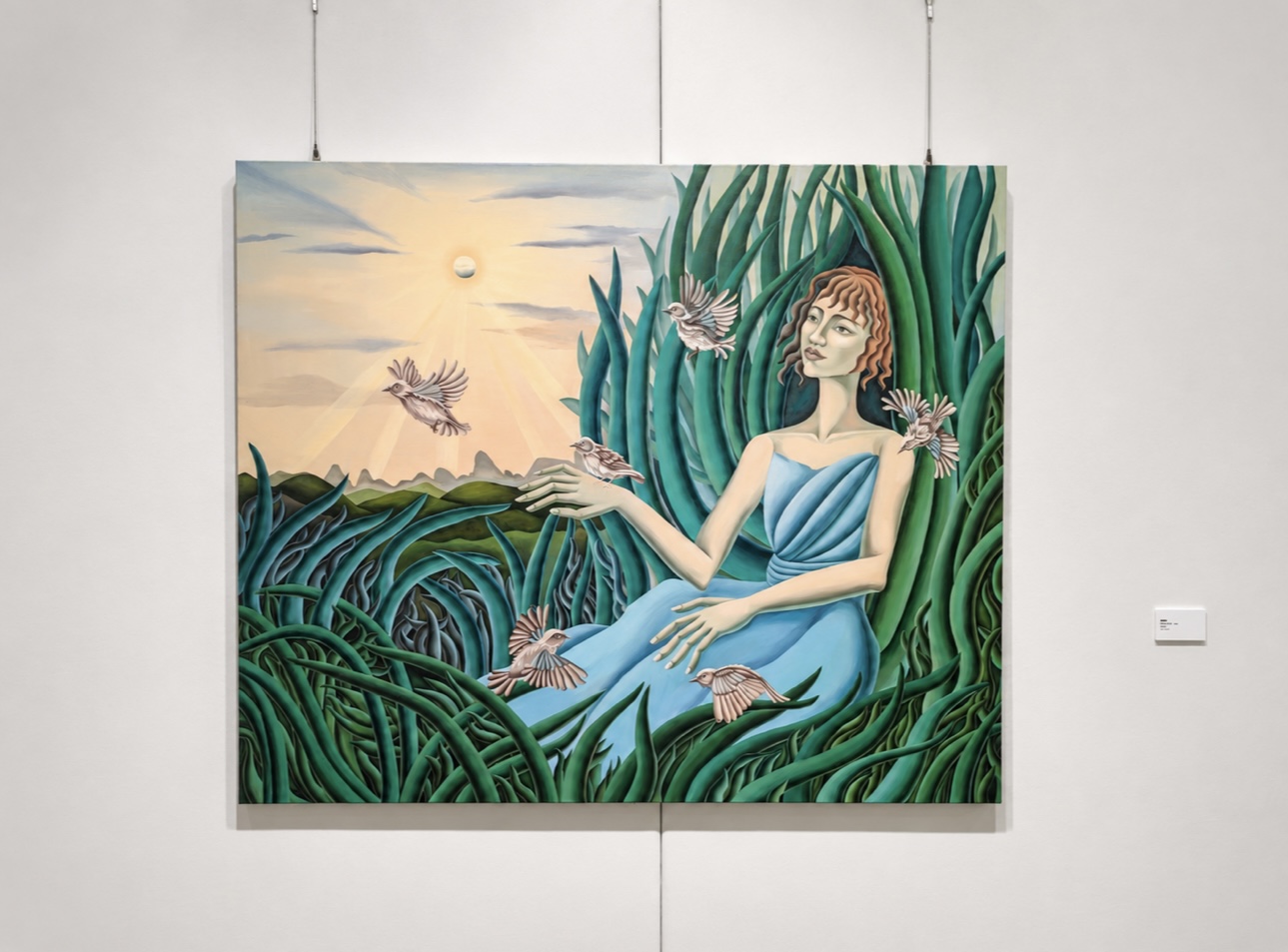
Wanlin Yan’s Birds in the Dense Forest approaches attention through what it leaves unsaid. Vegetation surrounds the figure, giving the scene a sense of shelter without resolving its story. The composition guides the eye, but it does not tell us precisely what has happened to the person within it or what the landscape should mean. That openness is not a gap in the artist’s thinking. It is a narrative choice. Yan shapes the conditions of looking without supplying the viewer’s final judgment.
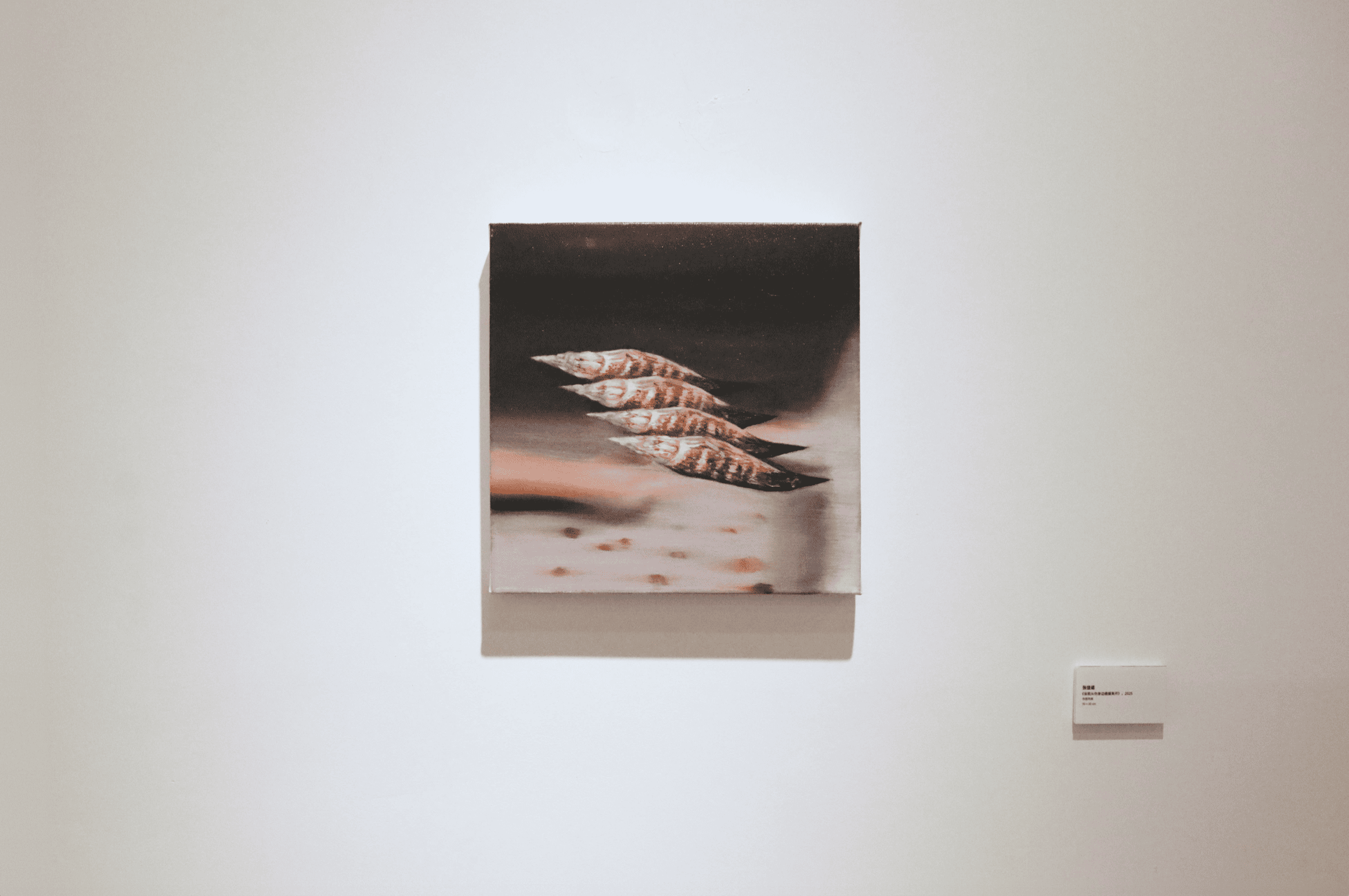
Jianuo Zhang takes the question into the tools of contemporary image-making. For When I Slowly Walked Away from You, she used Recraft to generate a background, then worked her own photographs of conch shells into the composition, stretching and recombining them along the way. The resulting image still had to pass through her judgment. Texture, color, arrangement, and the possibility of an emotional connection could not be left to the software. Her experience complicates the assumption that using generative AI means accepting whatever it produces. Once a tool enters the studio, the artist’s decisions do not disappear. They become part of the work in a newly visible way.
Placed alongside one another, these four accounts shift attention away from the vague idea of simply looking harder. It becomes a set of concrete choices: returning to a window, allowing a physical gesture to remain on the canvas, withholding part of a story, or questioning a digital image that appears finished. Yuchen Hou described this quality of the talk as a relationship among distinct voices. The artists need not share a method or an answer for their practices to speak to one another.
What Changes in the Gallery
In a straightforward chronology, the artists’ “answers” often existed before the curator’s “question.” Many works were completed long before the exhibition acquired its title; they were not made to illustrate a theme. Question and answer, then, is only a useful metaphor up to a point. A curatorial proposition can provide a way into the work, but it is not a questionnaire to which every artist must respond. Once a work enters a group exhibition, it encounters objects from other bodies of work, the physical character of the space, and the experiences visitors bring with them. Its material form may remain unchanged between a studio, a solo show, an art fair, and a group exhibition. Yet the attention it receives, and what comes to matter about it, may be quite different.
The juxtaposition of Youyuan Wang and Étémé offers a good example. Both make use, to varying degrees, of abstraction or nonrepresentational form, but that does not place them in the same artistic school. In the works shown here, Wang’s attention is evident in the handling of detail, the calibration of color, and the restraint of the overall composition. Étémé leaves more direct evidence of bodily rhythm in the marks and material surface. It would be too easy, and plainly misleading, to cast this as “Chinese rigor” against “Western freedom.” Artistic training, working methods, and individual histories matter far more than that cultural shorthand. Seen in proximity, their paintings make two different forms of attention available for comparison.
An installation decision made this kind of exchange especially tangible. One wall at MUYAO was gray stone. Chen initially considered leaving it empty: its rough, insistent texture seemed likely to compete with a painting in a way a conventional white wall might not. He eventually hung Pinnow’s Glimpse there. The painted window suggested an opening onto another space, while the wall itself asserted a material sense of enclosure. After Pinnow spoke in the artist talk about windows and architecture, the relationship took on another dimension. The stone did not prove the painting’s “true” meaning. It brought forward a possibility that might have remained less apparent in a different setting.
Brian O’Doherty’s analysis of the white cube reminds us that a supposedly neutral gallery is already a constructed setting that shapes the act of looking [1]. Umberto Eco’s account of the open work provides another point of reference: an artwork’s possibilities for interpretation are not exhausted when its maker finishes it [2]. In thinking through this exhibition, Chen has tentatively used the term Liminal Concept (LC) for the moment when a work enters a particular viewing relationship and established meanings begin to coexist with new ones. LC is not proposed as a fixed property of the artwork. It names a changing condition in which interpretations overlap, pull against one another, and alter what becomes visible. The term borrows from Victor Turner’s account of liminal or transitional states, but its use here is an extension into exhibition-making, not a theory of art Turner himself developed [3]. It becomes tangible in the encounter between Glimpse and the stone wall, or in the movement between Wang’s and Étémé’s paintings.
Improvisation, Not Consensus
The artist talk also showed that several voices in conversation do not necessarily arrive at agreement. On generative AI, Hou argued that artists should take an active part in understanding and testing emerging technologies. Otherwise, those technologies will shape the future of image production without artists having much say in it. The discussion also raised the resources these systems consume and their environmental consequences. If an artist’s work is concerned with plants, living systems, or nature, should the tools used to make it also become part of the ethical conversation? These positions approach the problem from different directions. One asks how artists retain agency; the other asks what responsibilities their methods carry. Their difference matters. There is no reason to edit it into a consensus that was never reached.
A symphony is a more fitting metaphor for this experience than a sequence of questions and answers. Its parts need not play the same melody. Artists bring works with histories of their own; an exhibition places them in a relationship; viewers make connections that could not all have been anticipated; and the talk brings something of the artists’ thinking back into the act of looking. It is structured, but it is not fully scripted. No curator can decide in advance exactly what every work will mean to everyone who encounters it, nor should a curator try.
The analogy of observation making one possibility visible can be helpful, provided it stays an analogy. Looking at art is not a quantum experiment, and recognizing one interpretation does not erase the rest. A group exhibition has room for several readings to remain in tension, changing with the next visitor, conversation, or arrangement of works. The value of Forms of Attention is not that it delivered a definitive answer to its own premise. It made space for independent voices to become audible to one another.
Seen together, the exhibition and the artist talk offered two connected forms of public encounter. In Shanghai, ten artists’ different materials, images, and spatial languages could be experienced side by side. Online, four of them returned to the judgments, memories, and unfinished questions behind their work. The exhibition gave these forms of attention a shared setting; the talk gave their differences room to be discussed. Neither erased the distance between artistic methods nor settled the questions raised about technology and responsibility. What emerged was a set of new ways to look at the work, along with a reason to keep testing those ways of looking. That exchange need not end when the exhibition closes or the discussion is over.
[1] O’Doherty, Brian. Inside the White Cube: The Ideology of the Gallery Space. Expanded ed. Berkeley: University of California Press, 1999.
[2] Eco, Umberto. The Open Work. Translated by Anna Cancogni, with an introduction by David Robey. Cambridge, MA: Harvard University Press, 1989.
[3] Turner, Victor W. The Ritual Process: Structure and Anti-Structure. Chicago: Aldine Publishing Company, 1969.