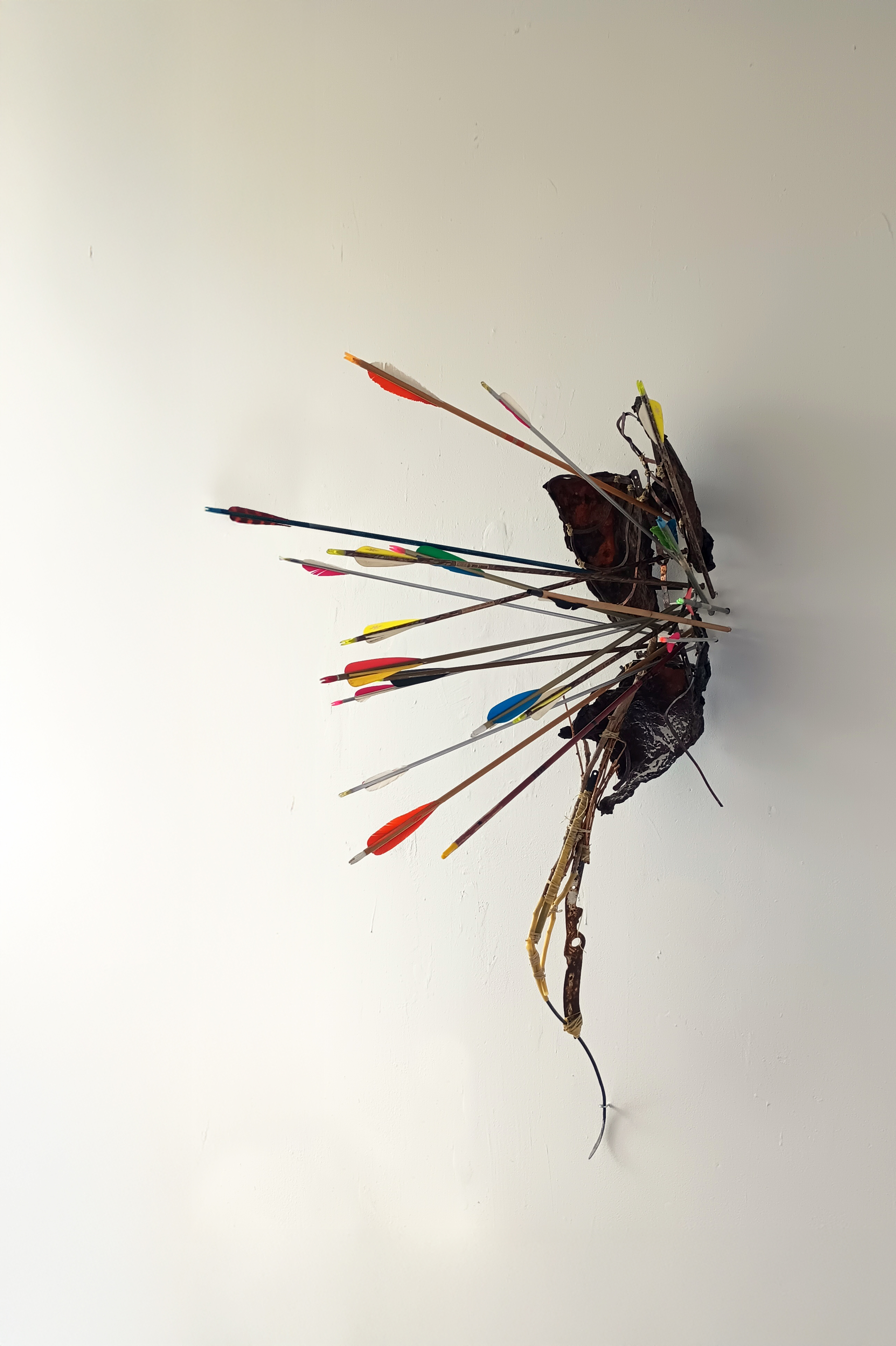
Arrows fan outward from a dark, curled mass pinned to the wall. Cazares uses dried bacterial cellulose, a material grown by bacteria, as a substitute for flesh. The arrows recall the martyrdom of Saint Sebastian: his suffering and death for his Christian faith. In many Renaissance paintings, his wounded body remains youthful and beautiful, bringing religious devotion into contact with physical attraction. His image later became important in gay and queer culture, where artists have explored its connections to desire and persecution.
Cazares gives the saint a shriveled, incomplete body, shifting attention toward its vulnerability. This raises a question about compassion: must a body be beautiful to deserve care? He brings the trans body into this discussion through his emphasis on bodily change. For Cazares, a person's worth does not depend on maintaining a fixed physical form. He finds a parallel in Christian ideas of the soul, whose value he sees as independent of outward appearance. His term post-beauty describes an outlook in which a body can be valued without first meeting an ideal of beauty. The changing body remains worthy of care, even when it departs from the forms viewers have learned to admire.